


Mexico's Taam Ja' Blue Hole is the deepest known underwater sinkhole in the world, researchers have discovered and they haven't even reached the bottom yet.
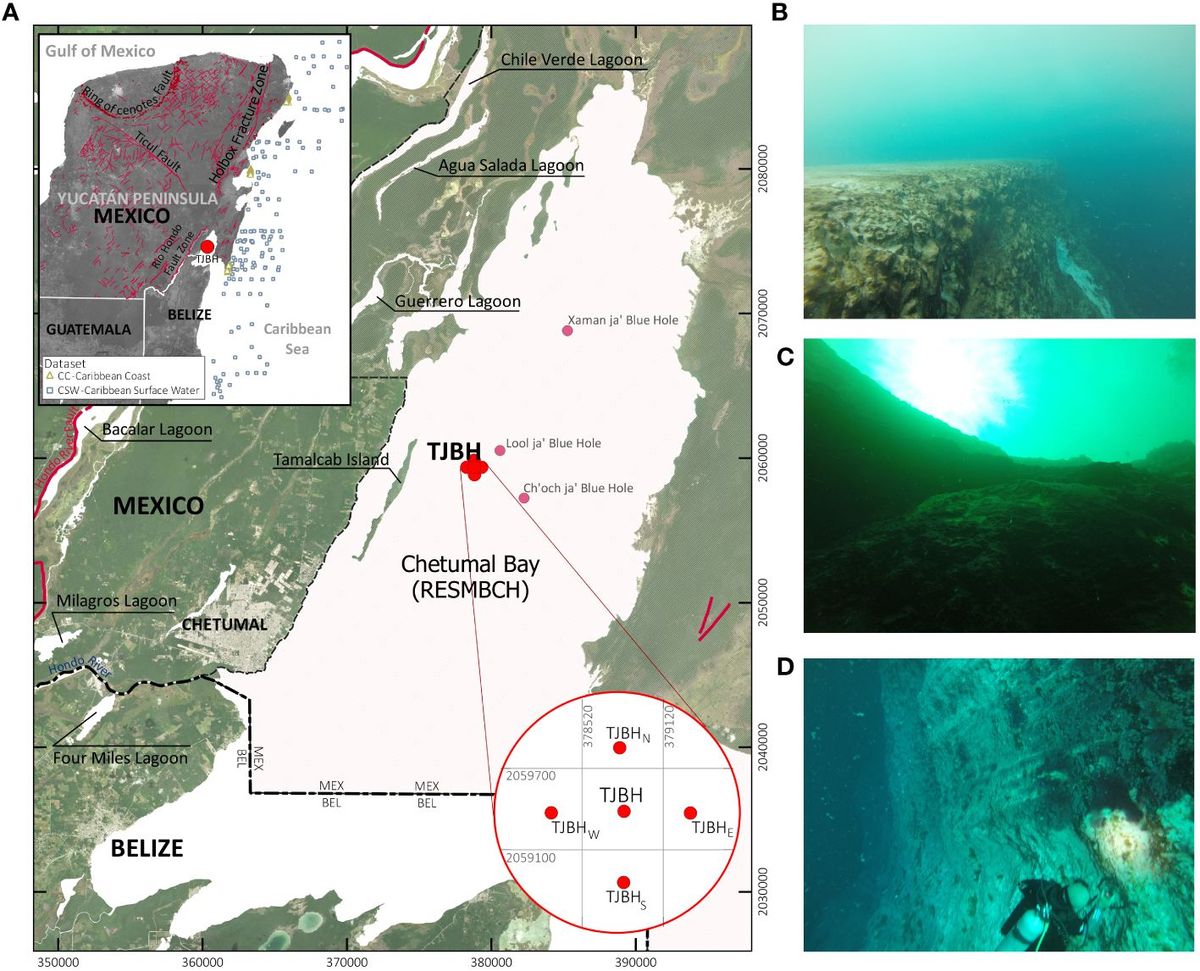
New measurements indicate the Taam Ja' Blue Hole (TJBH), which sits in Chetumal Bay off the southeast coast of the Yucatan Peninsula, extends at least 1,380 feet (420 meters) below sea level.
That's 480 feet (146 m) deeper than scientists initially documented when they first discovered the blue hole in 2021, and 390 feet (119 m) deeper than the previous record holder the 990-foot-deep (301 m) Sansha Yongle Blue Hole, also known as the Dragon Hole, in the South China Sea.
"On December 6, 2023, a scuba diving expedition was conducted to identify the environmental conditions prevailing at the TJBH," researchers wrote in a study published Monday (April 29) in the journal Frontiers in Marine Science. During the expedition, the researchers took measurements with a conductivity, temperature and depth (CTD) profiler a device with a set of probes that read and transmit water properties to the surface in real time via a cable. The data revealed that the Taam Ja' blue hole is "the world's deepest known blue hole, with its bottom still not reached," the researchers wrote in the study.
Related: Colossal cave in Mexico that formed 15 million years ago is even more enormous than we thought
The profiler also highlighted different layers of water within the blue hole, including a layer below 1,312 feet (400 m) where the temperature and salinity conditions resembled those of the Caribbean Sea and nearby coastal reef lagoons. This suggests the TJBH may be connected to the ocean via a hidden network of tunnels and caves, according to the study.
Blue holes are water-filled vertical caverns, or sinkholes, found in coastal regions where the bedrock is made of soluble material, such as limestone, marble or gypsum. They form when water on the surface percolates through the rock, dissolving minerals and widening cracks, which eventually causes the rock to collapse. Famous examples include Dean's Blue Hole in the Bahamas, the Dahab Blue Hole in Egypt and the Great Blue Hole in Belize.
Initial measurements of the TJBH were taken using an echo sounder an instrument that sends sound waves down to the bottom of the water and measures the speed they come back to calculate distance. However, there are limitations to echo sounding techniques in blue holes due to fluctuations in water density and the unpredictable shape of each hole, which may not be perfectly vertical.
"Confirmation of the maximum depth was not possible due to instrument limitations during the scientific expeditions in 2021," the researchers wrote in the study.
RELATED STORIESColossal underwater canyon discovered near seamount deep in the Mediterranean Sea
Fluid leaked from scuba diver's blood vessels after 100-foot cave dive in rare medical case
Hidden passage leads explorers to deepest cave Down Under
The CTD instrument used for the recent work did not find the bottom of the blue hole either, as it could only operate down to depths of 1,640 feet (500 m). Scientists lowered the profiler down to that depth, but the cable it was attached to may have drifted on underwater currents or bumped into a ledge that stopped the device in its tracks 1,380 feet down, according to the study.
Next, the scientists plan to"decipher TJBH's "maximum depth and the possibilities of forming part of an underwater intricate and potentially interconnected system of caves and tunnels," the researchers wrote.
"Within the depths of TJBH could also lie a biodiversity to be explored," they added.



 zpostcode
 Recruit
 weather
 mreligion
 Yellowpages
 sport
sport constellation
 shopping
 name
name game
game directory
 literature
 Word
Word tour
tour furnish
 Lottery
 tftnews
 lyrics
 News
News digital
 car
car dir
dir Edu
Edu Finance