zpostcode
Earth from space: Mysterious wave ripples across 'galaxy' of icebergs in Arctic fjord
Dec 29, 2025 3:36 AM

Quick factsWhere is it? Itilliarsuup Kangerlua fjord, Greenland [70.72910805, -50.71839266].

What's in the photo? A mysterious wave, or arc, rippling across the fjord's surface.

Which satellite took the photo? Landsat 9.

When was it taken? August 3, 2023.

This striking satellite photo captured a mysterious arc in an ethereal, iceberg-covered fjord deep within the Arctic Circle. Researchers proposed several possible explanations for the bizarre phenomenon, but we will likely never find out for sure what caused it.

The Itilliarsuup Kangerlua fjord is part of the Uummannaq Fjord system in Western Greenland, around 460 miles (740 kilometers) north of the country's capital Nuuk. The narrow waterway, which is around 1.6 miles (2.6 km) long, was carved by two glaciers, Sisoortartukassak and Kangilleq, which are separated by a small island at the base of the fjord, according to NASA's Earth Observatory.

During the summer, the fjord's surface becomes littered with thousands of tiny iceberg fragments that have sloughed off from the glaciers, making the water look like a starscape from a deep-field telescope image when viewed from above. However, the most interesting feature in the image is a thin white arc that spans across the fjord. This arc is most likely a displacement wave that was traveling up the fjord away from the ice masses, according to the Earth Observatory.

Related: 12 amazing images of Earth from space

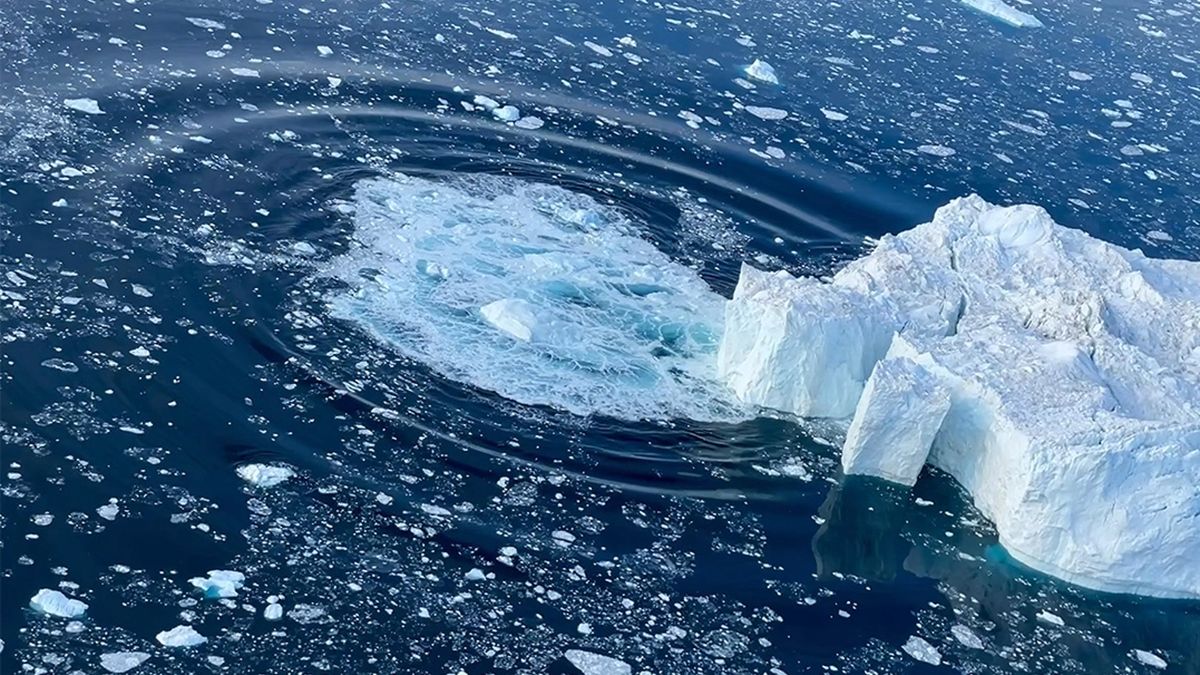
A photo of a large chunk of ice falling into the sea from a glacier, creating a circular wave

The wave may have been caused by a large chunk of ice breaking off from the Kangilleq glacier and falling into the water similar to the ripples you see when you throw a stone into a perfectly still lake.

"To me, it does look like a wave caused by a calving event," Josh Willis, an oceanographer at NASA's Jet Propulsion Laboratory, told the Earth Observatory. The "perfect shape" of the arc and orientation of the wave are similar to those of calving events observed in other glaciers, he added.

Dan Shugar,a geomorphologist at the University of Calgary, and Mike Wood, a glaciologist at Moss Landing Marine Laboratories in California, also believe the arc was the result of a calving event, according to the Earth Observatory.

related storiesTrippy satellite map of North America's largest glacier shows off 'hidden lagoon' and other secrets

Ethereal ice swirls dance around Arctic peninsula in stunning new satellite image

ISS astronaut captures constellation of icebergs in amazing space photos

However, the wave could also be caused by an "underwater plume" coming from the Kangilleq glacier, Willis said. Such plumes are made from fresh meltwater that enters salty fjord water from beneath the glacier and rises to the surface, displacing the water around it, he added.

But it is hard to be sure what caused the wave without more data. "Based on satellite images alone, it might never be known with certainty what caused [the] ephemeral feature," Earth Observatory representatives wrote.

Comments
Welcome to zpostcode comments! Please keep conversations courteous and on-topic. To fosterproductive and respectful conversations, you may see comments from our Community Managers.
Sign up to post
Sort by
Show More Comments
Recommend >
West African crocodile
  Also called: desert crocodile or sacred crocodile (Show more) West African crocodile, (Crocodylus suchus), large species of crocodile inhabiting forested swamps, marshes, freshwater rivers and streams, and even some arid regions of western and central Africa. The West African crocodile is found from Senegal and The Gambia eastward to Somalia and from Chad, Niger, and Mauritania southward as far as...
Earth from space: Trio of multicolor lakes look otherworldly in Africa's Great Rift Valley
Quick factsWhere is it? Great Rift Valley, Ethiopia [7.518881, 38.650099]. What's in the photo? From left to right: Lake Shala, Lake Abijatta and Lake Langano. Which satellite took the photo? Landsat 8. When was it taken? March 29, 2022. The trio of lakes in this striking image each have a different color thanks to a combination of factors including depth,...
George Clinton
  In full: George Edward Clinton (Show more) Born: July 22, 1941, Kannapolis, North Carolina, U.S. (age 82) (Show more) George Clinton (born July 22, 1941, Kannapolis, North Carolina, U.S.) is a highly influential funk music singer, songwriter, and musician who organized and produced Parliament-Funkadelic, a genre-bending theatrical collective of performers who defined funk music in the 1970s. Clinton grew up...
Hundreds of emperor penguin chicks spotted plunging off a 50-foot cliff in 1st-of-its-kind footage
Emperor penguin chicks have been recorded hurling themselves from a 50-foot (15 meters) cliff in Antarctica for the first time. The unprecedented footage, captured at Atka Bay in Northern Antarctica, shows roughly 700 fledglings braving a sheer drop to embark on their first swim in the ocean below. I had no idea that the chicks would be able to make...
Information Recommendation
uMkhonto weSizwe Party
  Also known as: MK Party (Show more) uMkhonto weSizwe Party, South African political party formed in 2023. It is commonly referred to as the MK Party. The party takes its name from Umkhonto we Sizwe (“Spear of the Nation”), the apartheid-era military wing of the African National Congress (ANC) liberation movement and, later, political party. Former South African president and...
What's the largest waterfall in the world?
Even our tallest buildings can't rival the staggering size of the world's most iconic waterfalls, which include Niagara Falls on the U.S. border to Canada, Victoria Falls in Zimbabwe and Zambia and Angel Falls in Venezuela. But which of these is the world's largest waterfall? Angel Falls is the tallest waterfall on land, measuring 3,212 feet (979 meters) high and...
Scientists may have pinpointed the true origin of the Hope Diamond and other pristine gemstones
Researchers may have found the true origin of the Hope Diamond, the Koh-i-noor and other famous, flawless gemstones. These diamonds, known collectively as the Golconda diamonds, are special because they have few inclusions and are very low in nitrogen, making them very clear and free of sparkle-disrupting flaws. They are also large. The Koh-i-noor, now one of the British Crown...
Jesse Plemons
  In full: Jesse Lon Plemons (Show more) Born: April 2, 1988, Dallas, Texas, U.S. (age 36) (Show more) Jesse Plemons (born April 2, 1988, Dallas, Texas, U.S.) is an American actor known for an understated, natural acting style that has made him popular with fans and critics alike. Plemons is typically cast in character roles, and his notable credits include...
We Are the World
  On January 28, 1985, more than 45 of the era’s most popular singers and songwriters gathered to record a song to raise funds for the charity USA for Africa. The song, “We Are the World,” released on March 7 that year, was an immediate media sensation. It sold an astonishing 800,000 copies in three days and ultimately raised more than...
'Uncharted territory': El Niño to flip to La Niña in what could be the hottest year on record
El Nio is likely to give way soon, ushering in a quick switch to its opposite atmospheric and ocean pattern, La Nia. For the U.S., this climatological flip-flop will likely mean a greater risk of major hurricanes in the Atlantic as well as areas of drier-than-usual weather in the southern portions of the country. Globally, La Nia usually leads to...
Natalia Grossman
  Born: June 22, 2001, Santa Cruz, California, U.S. (Show more) Natalia Grossman (born June 22, 2001, Santa Cruz, California, U.S.) is a multidiscipline sport climber who is considered one of the leading competitors in bouldering. A standout from an early age, Grossman won her first world championship in 2021 at age 20. She also has excelled in lead climbing and...
Half of China's cities are sinking, putting most of the country's urban population at risk
Nearly half of China's major cities are sinking due to groundwater extraction and the sheer weight of urban buildings and infrastructure, a new study finds. The affected cities, which include Beijing and Tianjin, are concentrated in the eastern part of the country and along the coast. Combined with sea level rise, falling cities could expose around 10% of China's coastal...