zpostcode
Hundreds of emperor penguin chicks spotted plunging off a 50-foot cliff in 1st-of-its-kind footage
Jan 2, 2026 1:53 AM

Emperor penguin chicks have been recorded hurling themselves from a 50-foot (15 meters) cliff in Antarctica for the first time.

The "unprecedented" footage, captured at Atka Bay in Northern Antarctica, shows roughly 700 fledglings braving a sheer drop to embark on their first swim in the ocean below.

"I had no idea that the chicks would be able to make such a giant leap, and not just survive but happily swim off together into the Southern Ocean," Bertie Gregory, the filmmaker who captured the footage for National Geographic, said in the video. "How's that for your first swimming lesson?"

Related: 4 never-before-seen emperor penguin colonies discovered in Antarctica, thanks to poop smears spotted from space

Antarctic sea ice decline

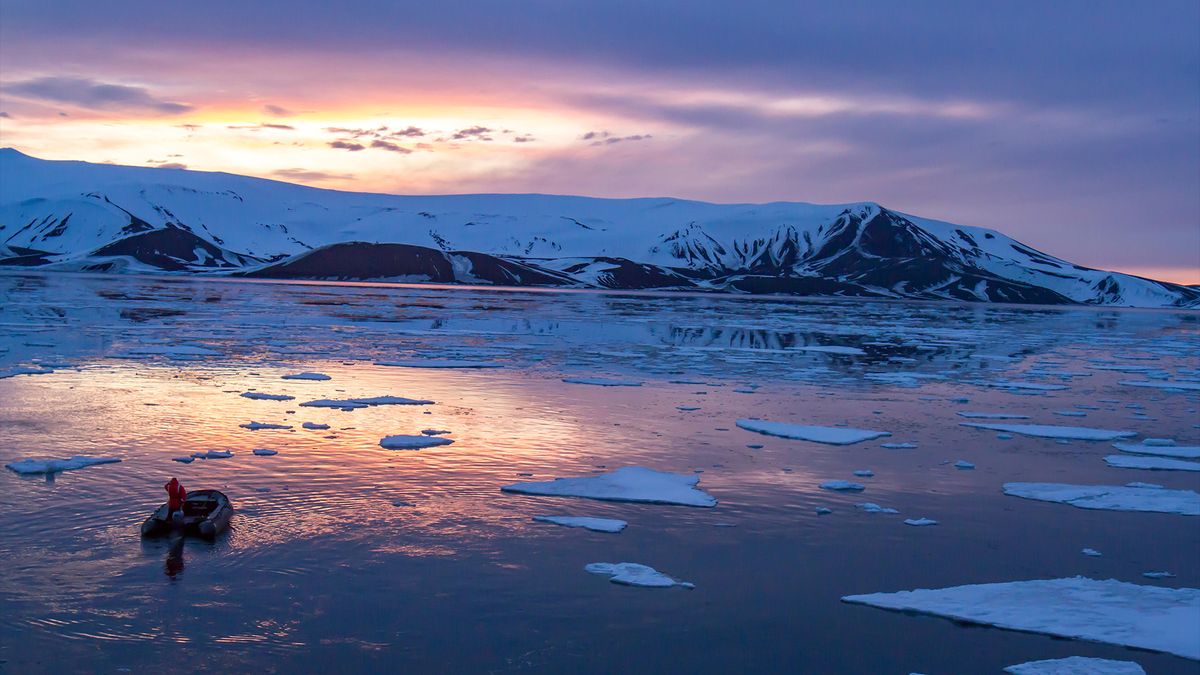
Deception Island, Antarctica.

(Image credit: karenfoleyphotography / Alamy Stock Photo)Antarctica's sea ice has been declining since 2016. What does that mean for Earth's climate?

Read more:

'2023 just blew everything off the charts': Antarctic sea ice hits troubling low for third consecutive year

Collapse of the West Antarctic ice sheet is 'unavoidable,' study finds

Antarctic sea ice reached 'record-smashing low' last month

Though it has been observed by scientists before, the behavior is unusual. The clip was filmed for National Geographic's miniseries "Secrets of the Penguins."

Typically, Emperor penguins (Aptenodytes forsteri) rear their young on free floating platforms of sea ice that blow from the ice shelf before slowly melting every year. When Emperor penguin fledglings reach the age of 5 months old, they lose their baby feathers and enter the water from a distance of roughly one or two feet (0.3 to 0.6 m).

But a recent and unprecedented decline in this ice has led scientists to theorize that it could be forcing the penguins to move onto the cliffs. The young penguins, motivated by hunger, must now make the dangerous plunge into the water to feed.

To capture the fledglings' stunning leap of faith, the researchers used a camera drone that let them film the rare behavior from the air without disturbing the penguins.

Until recently, Antarctic sea ice fluctuated between relatively stable summer minimums and winter maximums. But following a record minimum in 2016, things began to shift. Two record lows soon followed, including the smallest minimum ever in February 2023 at just 737,000 square miles (1.91 million square kilometers). As winter began in March 2023, the continent was missing a chunk of ice bigger than Western Europe.

"As a research community, we've struggled to even describe how unusual the change is. People throw around words like 'unprecedented' or 'gobsmacked' or 'unbelievable'," Edward Doddridge, a polar researcher who works on climate models for the region, told Live Science. "For a while we were trying to use statistics to say that it was a one in many thousands or millions of years event; then we got into billions and even into tens of billions of years," he added. "At some point along the way, you just have to realize that the statistics aren't useful to understand this anymore."

The decline in the ice has already had a profound effect on the region's penguins. Thousands of Emperor penguin chicks were found dead in West Antarctica in 2022, with scientists expecting to find even more deaths from 2023.

"Secrets of the Penguins" will premiere on National Geographic next year.

For more amazing Earth Month content, check out the ourHOME collection on Disney+. Learn more about the historic penguin leap at NatGeo.com.

Comments
Welcome to zpostcode comments! Please keep conversations courteous and on-topic. To fosterproductive and respectful conversations, you may see comments from our Community Managers.
Sign up to post
Sort by
Show More Comments
Recommend >
Swedish History Is Evident in These 14 Buildings
      Sweden’s history as a sovereign state stretches back a thousand years, though its boundaries were often changing until the early 19th century. These 14 buildings provide useful snapshots of how the country’s distant past has influenced its more recent history.   Earlier versions of the descriptions of these buildings first appeared in 1001 Buildings You Must See...
tarantula hawk
  tarantula hawk, (genus Pepsis), genus of about 130 species of spider wasps that paralyze spiders to feed their larval young. Tarantula hawks are found on every continent except Europe and Antarctica and are especially common in the southwestern United States through Central America. The tarantula hawk’s sting is said to be one of the most painful insect stings in the...
Arthropleura
  Arthropleura, genus of exceptionally large extinct millipede-like arthropods that thrived from the Viséan Age of the Carboniferous Period to the Asselian Age of the Permian Period (346.7 million to 293.52 million years ago) and are known from their fossilized exoskeletons. Members of Arthropleura are the largest known arthropods in Earth’s history, with an estimated length exceeding 2.6 meters (8.5 feet)—roughly...
megamouth shark
     megamouth shark (Megachasma pelagios)Schoolchildren looking into the tooth-lined mouth of a 4.2-meter- (13.8-foot-) long preserved megamouth shark (Megachasma pelagios) specimen at Tokai University Marine Science Museum in Shizuoka, Japan.(more)megamouth shark, (Megachasma pelagios), species of large filter-feeding sharks inhabiting the continental shelf and open-ocean regions of tropical and temperate oceans worldwide. The species is found between latitudes 40° N and...
Information Recommendation
Quetzalcoatlus
  Quetzalcoatlus, genus made up of two species of giant pterosaurs classified in the family Azhdarchidae, which contains some of the largest known flying animals. Both species lived during the Maastrichtian Age (72.1 million to 66 million years ago) of the Cretaceous Period. One of them, Quetzalcoatlus northropi, is widely believed to have been the largest flying creature that ever lived....
reticulated python
     reticulated python (Malayopython reticulatus)Reticulated python (Malayopython reticulatus) coiling around a branch. One individual of this species of Asian python attained a length of 10 meters (32.8 feet).(more)reticulated python, (Malayopython reticulatus), species of giant constricting snake belonging to the python family, Pythonidae, and known for being the longest living snake in the world, with the largest recorded individual measuring 10...
These 8 Buildings Will Make You See Norway in a New Light
      Norway, by some estimates, is two-thirds mountainous, and about half of its population lives in the south of the country, where its capital, Oslo, is located. These eight contemporary buildings will give you another lens through which to see this Scandinavian country.   Earlier versions of the descriptions of these buildings first appeared in 1001 Buildings You Must...
Burmese python
  Burmese python, (Python bivittatus), species of constrictor snake that is native to various environments in southern and Southeast Asia, including several islands in Indonesia, and is known for its exceptional size and its environmental adaptability. Burmese pythons inhabit mangrove forests, rainforests, swamps, grasslands, rivers, and rocky areas, in a range extending from Nepal, Bangladesh, northeastern India, and Myanmar (Burma) eastward...
The Largest Islands in the World
      Quite a few islands around the world are very large, and many of them are countries. Australia is technically an island because it is unconnected to any other body of land, but it is more commonly considered a continental landmass. Of the seven continents, Australia is the smallest, at 2,969,976 square miles, or 7,692,202 square kilometers. However,...
American crocodile
     American crocodile (Crocodylus acutus)American crocodiles (Crocodylus acutus) basking in the sun in Costa Rica. Usually solitary, the reptiles bask for most of the day and then enter the water during the evening to hunt.(more)American crocodile, (Crocodylus acutus), moderately large species of crocodile inhabiting forests and freshwater environments, as well as brackish and marine intertidal environments, in Florida, Central America,...
American alligator
  American alligator, (Alligator mississippiensis), species of alligator inhabiting freshwater rivers, lakes, and swamps and brackish waters in the Southern U.S. and northeastern Mexico. The alligator’s geographic range extends from the Mexican states of Coahuila, Nuevo León, and Tamaulipas northeastward to Oklahoma and Arkansas and eastward through the Gulf Coast to North Carolina, South Carolina, Georgia, and Florida. The species is...
spectacled caiman
  spectacled caiman, (Caiman crocodilus), species of alligator-like reptiles common to swamps, other wetlands, and waterways in Central America and northern South America. The spectacled caiman takes its name from its most prominent distinguishing feature, a bony ridge between the eyes that resembles the nosepiece of a pair of eyeglasses. The species has adapted to a wide variety of habitats, and...