zpostcode
Underwater robot in Siberia's Lake Baikal reveals hidden mud volcanoes — and an active fault
Aug 9, 2026 3:44 PM

A robot deployed to the bottom of Siberia's Lake Baikal last summer captured footage of cracks and deformations caused by previously unknown mud volcanoes and you can watch the discovery in a video below.

The robot discovered scars left behind by eruptions of mud at depths of 340 to 540 feet (100 to 165 meters) in two locations Malaya Kosa Bay and Goryachinskaya Bay along the northwestern shore of the lake. Although scientists already knew Lake Baikal harbored mud volcanoes, the latest find sits uncomfortably close to a fault zone known as the Severobaikalsk, or North Baikal fault, which straddles the lakeshore. Signs of recent eruptions at the bottom of the lake could indicate the fault is active.

Mud volcanoes are surface expressions of deeper geological processes and form as a result of slurries and gases erupting from below. Craters along Lake Baikal's northwestern shore "mark cracks that run parallel to the Severobaikalsk fault" and indicate the fault "is alive," according to Oksana Lunina, a structural geologist and chief researcher at the Institute of the Earth's Crust in the Siberian Branch of the Russian Academy of Sciences (SBRAS) who participated in the discovery.

"In the North Baikal depression, which is limited by this fault, there have been strong earthquakes in the past," Lunina said in a translated statement.

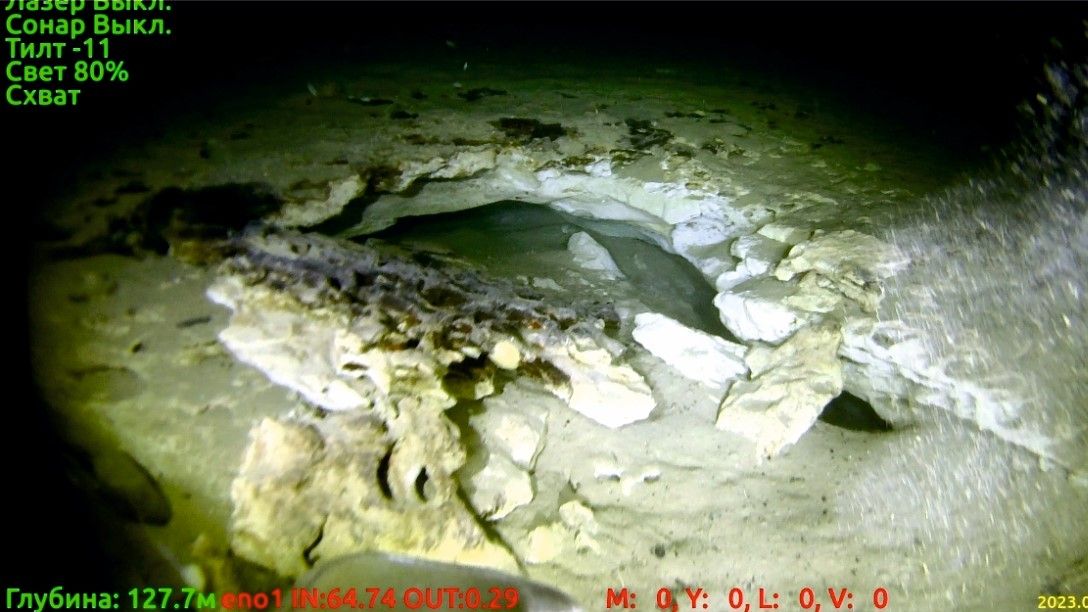
The two sites where researchers deployed the robot, or autonomous underwater vehicle (AUV), showed intensely fractured beds blanketed with clay, soft sediments and erupted deposits. In the northernmost Goryachinskaya Bay location, where the footage was taken, craters around 430 feet (130 m) deep were overflowing with a "mud mass," indicating an eruption had occurred recently, according to a study published in October 2023 in the journal Doklady Earth Sciences.

Related: 'Worrisome and even frightening': Ancient ecosystem of Lake Baikal at risk of regime change from warming

The footage shows layers of rock that were torn and forced up by eruptions of mud and gas-saturated fluids. Boulders appeared to have been "squeezed out" from below, and the dusting of clay and silt on top looked disturbed and porous, the researchers noted in the study.

Deeper in Goryachinskaya Bay, around 525 feet (160 m) below the surface, researchers spotted hundreds of small, cone-shaped craters. "They are everywhere accompanied by brittle deformations of the bottom," they wrote in the study. The vents, which were 2 inches (5 centimeters) tall and across, were teeming with amphipods and gastropods, while nearby hard surfaces hosted colonies of white sponges.

Fragments of a mud volcano at the bottom of Lake Baikal.

As the AUV traveled to slightly shallower depths, "it became apparent that the entire steep slope was densely covered with mud volcanoes," the researchers added. Mud volcanoes normally wouldn't form at such shallow depths, because they require high temperatures and pressures, Lunina said in the statement.

RELATED STORIESWatch drone delve into Siberia's growing 'gateway to the underworld,' the largest permafrost depression in the world

Mystery of Siberia's giant exploding craters may finally be solved

Nematode resurrected from Siberian permafrost lay dormant for 46,000 years

Mud volcanoes in Lake Baikal are typically fed by gas hydrates, which are crystals of water and gas that form beneath bodies of water. Gas hydrates can become unstable in regions where tectonic processes are at play, due to the additional heat that is created in Earth's crust, Lunina told Live Science in an email.

"But our finding could have another mechanism," Lunina said. Small movements and earthquakes in the Severobaikalsk fault could cause slurries to rise up and erupt through the bottom of Lake Baikal, she said.

These fountains of mud and dissolved gases are unlikely to disturb the lake depths. "It must be a part of the Baikal ecosystem," Lunina said.

Video cameras mounted on the underwater vehicle were operated by study co-author Konstantin Kucher, a researcher at the Limnological Institute in the Siberian Branch of the Russian Academy of Sciences, Irkutsk.

Comments
Welcome to zpostcode comments! Please keep conversations courteous and on-topic. To fosterproductive and respectful conversations, you may see comments from our Community Managers.
Sign up to post
Sort by
Show More Comments
Recommend >
lo-fi music
  lo-fi music, genre of music production in which a recording is intentionally rendered to include imperfections, such as harmonic distortion, background noise, or other anomalous sounds. Such irregularities are normally filtered out of professional recordings, since they generally are undesirable. However, some artists have embraced the limitations of low-quality recording, leveraging imperfections as an artistic choice. The term lo-fi is...
tarantula hawk
  tarantula hawk, (genus Pepsis), genus of about 130 species of spider wasps that paralyze spiders to feed their larval young. Tarantula hawks are found on every continent except Europe and Antarctica and are especially common in the southwestern United States through Central America. The tarantula hawk’s sting is said to be one of the most painful insect stings in the...
Caitlin Clark
  Caitlin Clark (born January 22, 2002, Des Moines, Iowa, U.S.) is one of the greatest players in the history of women’s college basketball, especially known for her scoring. As a guard for the University of Iowa in 2024, Clark became the all-time leading scorer in NCAA basketball, surpassing Pete Maravich’s record of 3,667 points. Her widespread popularity has helped increase...
Geoffrey Hinton
  Geoffrey Hinton (born December 6, 1947, London, England) is a British-Canadian cognitive psychologist and computer scientist known as the “godfather of AI.” He revolutionized the field of artificial intelligence with his work on neural network models. He contributed significantly to AI research with novel insights and key discoveries in the areas of backpropagation, Boltzmann machines, distributed representations, and time-delay neural...
Information Recommendation
Billy Crudup
  Billy Crudup (born July 8, 1968, Manhasset, New York, U.S.) is an American stage and screen actor who has had a long and steady career playing complex characters within an ensemble cast. He is perhaps best known for his roles as rock star Russell Hammond in Almost Famous (2000) and as network executive Cory Ellison in the streaming series The...
Azurá Stevens
  Azurá Stevens (born February 1, 1996, Pawtucket, Rhode Island, U.S.) is an American basketball player who is known for her mobility, defensive play, and shooting ability. As a power forward and center for the Chicago Sky, she helped win a WNBA title in 2021. Two years later Stevens led the U.S. team to a gold medal in the 3×3 competition...
Caeleb Dressel
  Caeleb Dressel (born August 16, 1996, Green Cove Springs, Florida, U.S.) is one of the world’s elite swimmers, known as a sprint specialist for his performances in the 50 meters and 100 meters. He has seven Olympic gold medals, five of which were won at the 2020 Tokyo Games (delayed until 2021 because of the COVID-19 pandemic). With his numerous...
Freddie Freeman
  Freddie Freeman (born September 12, 1989, Villa Park, California, U.S.) is a professional baseball player and star first baseman whose successful career track makes him a likely future candidate for induction into the Baseball Hall of Fame. A sweet-swinging left-handed hitter and an outstanding fielder, he has also been called the “friendliest man in baseball.” Freeman made his Major League...
Biruté Galdikas
     The Trimates, or Leakey's AngelsPrimatologists (from left) Biruté Galdikas, Jane Goodall, and Dian Fossey are popularly known as “the Trimates” and “Leakey's Angels.”(more)Biruté Galdikas (born May 10, 1946, Wiesbaden, Germany) is a primatologist, conservationist, and educator who, having dedicated more than half a century to the study of orangutans in Indonesian Borneo, is credited with conducting the longest-running longitudinal...
Christopher Guest
  Christopher Guest (born February 5, 1948, New York City, New York, U.S.) is a multitalented American-British actor, writer, producer, director, and musician best known for his satirical faux-documentary-style comedies, including This Is Spinal Tap (1984), Best in Show (2000), and A Mighty Wind (2003).   Early life and education Guest’s British-born father, Lord Peter Haden-Guest, served as editorial director at the...
Boris Nemtsov
  Boris Nemtsov (born October 9, 1959, Sochi, Russia, U.S.S.R.—died February 27, 2015, Moscow, Russia) was a leading figure in the opposition movement for free-market economics and democratic social reforms in postcommunist Russia. After the rise of Vladimir Putin to the country’s presidency, Nemtsov became one of Putin’s most visible and outspoken critics within Russia’s political class. In February 2015 he...
Bobi Wine
  Bobi Wine (born February 12, 1982, Nkozi, Mpigi district, Uganda) is a Ugandan politician, performer, and activist who first garnered acclaim for his popular hits and socially conscious songs he called “edutainment”—the fusion of education and entertainment. He later became known for being a vocal critic of Ugandan Pres. Yoweri Museveni (1986– ) and his administration. Wine ran against Museveni...