zpostcode
Earth from space: Mysterious wave ripples across 'galaxy' of icebergs in Arctic fjord
Mar 29, 2026 3:34 PM

Quick factsWhere is it? Itilliarsuup Kangerlua fjord, Greenland [70.72910805, -50.71839266].

What's in the photo? A mysterious wave, or arc, rippling across the fjord's surface.

Which satellite took the photo? Landsat 9.

When was it taken? August 3, 2023.

This striking satellite photo captured a mysterious arc in an ethereal, iceberg-covered fjord deep within the Arctic Circle. Researchers proposed several possible explanations for the bizarre phenomenon, but we will likely never find out for sure what caused it.

The Itilliarsuup Kangerlua fjord is part of the Uummannaq Fjord system in Western Greenland, around 460 miles (740 kilometers) north of the country's capital Nuuk. The narrow waterway, which is around 1.6 miles (2.6 km) long, was carved by two glaciers, Sisoortartukassak and Kangilleq, which are separated by a small island at the base of the fjord, according to NASA's Earth Observatory.

During the summer, the fjord's surface becomes littered with thousands of tiny iceberg fragments that have sloughed off from the glaciers, making the water look like a starscape from a deep-field telescope image when viewed from above. However, the most interesting feature in the image is a thin white arc that spans across the fjord. This arc is most likely a displacement wave that was traveling up the fjord away from the ice masses, according to the Earth Observatory.

Related: 12 amazing images of Earth from space

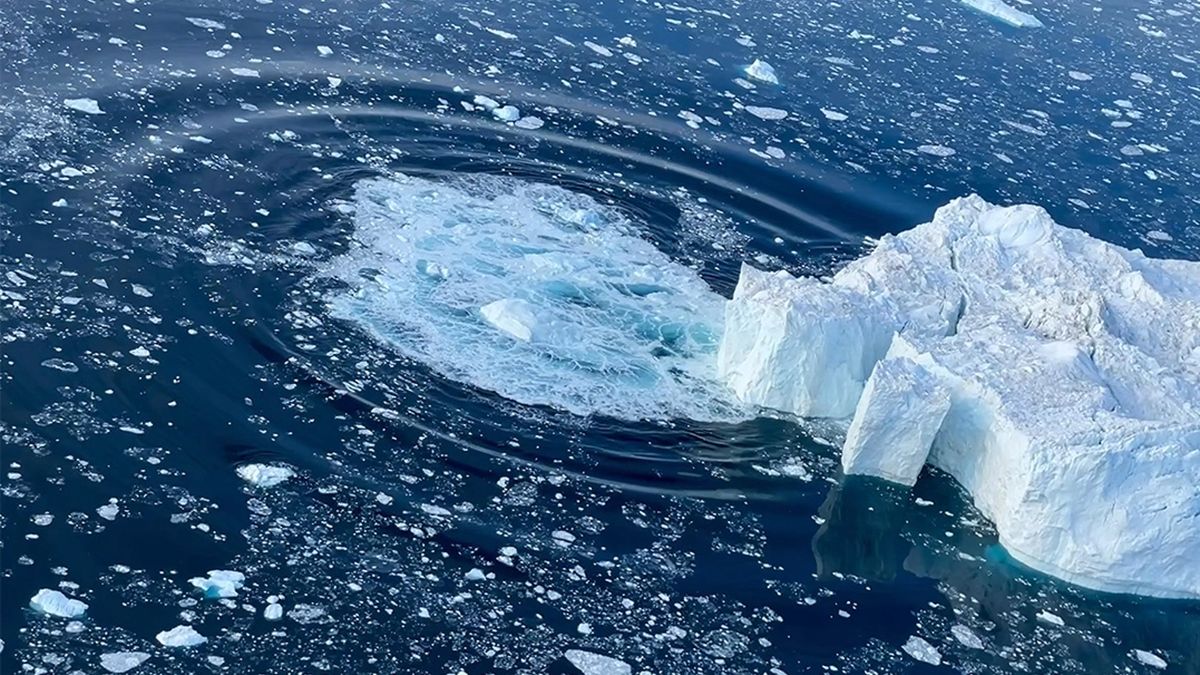
A photo of a large chunk of ice falling into the sea from a glacier, creating a circular wave

The wave may have been caused by a large chunk of ice breaking off from the Kangilleq glacier and falling into the water similar to the ripples you see when you throw a stone into a perfectly still lake.

"To me, it does look like a wave caused by a calving event," Josh Willis, an oceanographer at NASA's Jet Propulsion Laboratory, told the Earth Observatory. The "perfect shape" of the arc and orientation of the wave are similar to those of calving events observed in other glaciers, he added.

Dan Shugar,a geomorphologist at the University of Calgary, and Mike Wood, a glaciologist at Moss Landing Marine Laboratories in California, also believe the arc was the result of a calving event, according to the Earth Observatory.

related storiesTrippy satellite map of North America's largest glacier shows off 'hidden lagoon' and other secrets

Ethereal ice swirls dance around Arctic peninsula in stunning new satellite image

ISS astronaut captures constellation of icebergs in amazing space photos

However, the wave could also be caused by an "underwater plume" coming from the Kangilleq glacier, Willis said. Such plumes are made from fresh meltwater that enters salty fjord water from beneath the glacier and rises to the surface, displacing the water around it, he added.

But it is hard to be sure what caused the wave without more data. "Based on satellite images alone, it might never be known with certainty what caused [the] ephemeral feature," Earth Observatory representatives wrote.
Comments
Welcome to zpostcode comments! Please keep conversations courteous and on-topic. To fosterproductive and respectful conversations, you may see comments from our Community Managers.
Sign up to post
Sort by
Show More Comments
Recommend >
Battle of the Crater
  Battle of the Crater, Union defeat on July 30, 1864, during the American Civil War (1861–65), part of the Siege of Petersburg, Virginia. In the final full year of the war, Union forces besieged the town of Petersburg, to the south of the Confederate capital of Richmond. But a well-conceived attempt to end the stalemate of trench warfare and break...
Battle of Balaklava
  Battle of Balaklava, also spelled Balaclava, (Oct. 25 [Oct. 13, Old Style], 1854), indecisive military engagement of the Crimean War, best known as the inspiration of the English poet Alfred, Lord Tennyson’s “Charge of the Light Brigade.” In this battle, the Russians failed to capture Balaklava, the Black Sea supply port of the British, French, and Turkish allied forces in...
Battle of Moscow
  Battle of Moscow, battle fought between Nazi Germany and the Soviet Union from September 30, 1941 to January 7, 1942, during World War II. It was the climax of Nazi Germany’s Operation Barbarossa, and it ended the Germans’ intention to capture Moscow, which ultimately doomed the Third Reich.   The German advance on Moscow in September 1941 was soon in trouble...
Battle of Jumonville Glen
  Battle of Jumonville Glen, opening battle of the French and Indian War, fought on May 28, 1754, also noteworthy as the combat action for George Washington. Imperial ambitions brought England and France into conflict in the Ohio River Valley, forming a theater in the global Seven Years’ War, of which, it is believed, the Battle of Jumonville Glen was the...
Information Recommendation
Battle of Corregidor
  Battle of Corregidor, the successful recapture by U.S. troops on February 16–March 2, 1945, during World War II, of Corregidor Island. Located at the entrance of Manila Bay in the Philippines, Corregidor had been called the “Gibraltar of the East.” The fort had been surrendered to invading Japanese forces on May 6, 1942, marking the fall of the Philippines to...
Battle of Santo Domingo
  Battle of Santo Domingo, British naval victory over a French flotilla during the Napoleonic Wars, fought in the waters off the southern coast of what is now the Dominican Republic, in the Caribbean, on February 6. 1806. Although unwilling after the Battle of Trafalgar (1805) to face Britain in a full-scale fleet battle, the French navy was still able to...
Battle of Kasserine Pass
  Battle of Kasserine Pass, the first large-scale encounter in World War II between Italian and German land forces and the U.S. army, fought February 14–24, 1943. The Axis offensive along the Kasserine Pass, in a gap in the Atlas Mountains of west-central Tunisia, resulted in a humiliating setback for the Americans, but they recovered quickly and prevented the Axis forces...
Battle of Gibraltar
  Battle of Gibraltar, naval battle fought on April 25, 1607, between ships of the Spanish Empire and the Dutch United Provinces. After their loss at the Battle of Ostend, the Dutch United Provinces intensified their maritime campaign against Spain. This culminated in the breathtakingly bold raid on the Spanish fleet in harbor at Gibraltar, one of the most celebrated Dutch...
Battle of Smolensk
  Battle of Smolensk, engagement of the Napoleonic Wars fought in eastern Russia on August 16–18, 1812, and the first large-scale battle of the French campaign in Russia. When Napoleon invaded Russia in June 1812, he led a multinational army of more than half a million soldiers. He needed a rapid and decisive victory, but although victorious at Smolensk, some 230...
Battle of Santiago de Cuba
  Battle of Santiago de Cuba, concluding naval engagement, of the Spanish-American War, fought on July 3, 1898, near Santiago de Cuba, Cuba, a battle that sealed the U.S. victory over the Spaniards.   On May 19, 1898, a month after the outbreak of hostilities between the two powers, a Spanish fleet under Admiral Pascual Cervera arrived in Santiago harbour on the...
Battle of Carthage
     How Hannibal's conquests led to the fall of CarthageOverview of the rise and fall of Carthage, with a detailed discussion of Hannibal's victories against Rome, including the Battle of Cannae, and his later defeat at the Battle of Zama.(more)See all videos for this articleThe Battle of Carthage in 146 bce ended generations of war between the Phoenician-founded city and...
Battle of Saint-Mihiel
  Battle of Saint-Mihiel, Allied victory and the first U.S.-led offensive in World War I, fought from September 12–16, 1918 . The Allied attack against the Saint-Mihiel salient provided the Americans with an opportunity to use the American Expeditionary Forces on the Western Front en masse and, for the first time, under their own command rather that under that of French...