zpostcode
Rare magnitude 4.8 and 3.8 earthquakes rock Northeast, including greater New York area
Dec 13, 2025 9:49 PM

Magnitude 4.8 and 3.8 earthquakes rocked the Northeast, including the Greater New York area, on Friday (April 5), according to the U.S. Geological Survey (USGS).

The first earthquake struck at 10:23 a.m. EDT at a depth of 2.9 miles (4.7 kilometers), USGS reported. It hit 4.3 miles (7 km) north of Whitehouse Station in New Jersey, about 40 miles (64 km) from Manhattan.

The second earthquake hit at 5:59 p.m. EDT at a depth of 5.8 miles (9.4 km), with an epicenter 4.3 miles (7 km) southwest of Gladstone, New Jersey, USGS reported. It was originally reported as a magnitude 4.0, but later downgraded to a magnitude 3.8 "based on more complete physical modeling," USGS said.

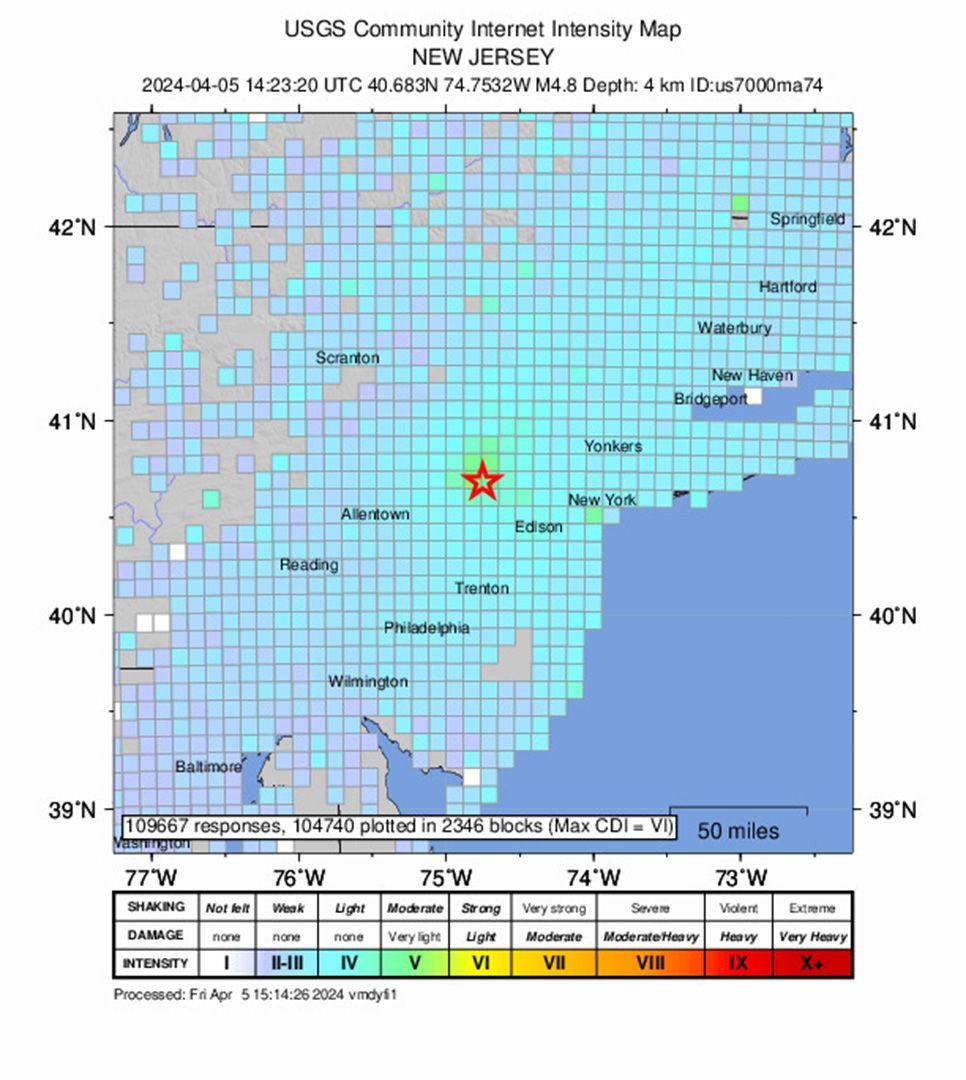
For the first quake, shaking was felt as far south as Baltimore, Maryland, and as far north as Springfield, Massachusetts, according to the USGS' "Did You Feel It?" map. Some airports on the East Coast issued ground stops to halt air traffic directly after the morning quake, but there were no immediate reports of damage, according to The New York Times.

Related: The 20 largest recorded earthquakes in history

Earthquakes in the Greater New York area are rare, but smaller and occasionally more powerful earthquakes have previously rattled this region spanning New York, Philadelphia and Wilmington. Smaller earthquakes hit around every two to three years, and larger ones strike roughly twice a century, according to USGS.

"It's unusual to get really big earthquakes in the Northeast of the U.S., but you do occasionally get these intermediate-size earthquakes, which is what we had this morning," Benjamin Fernando, a postdoctoral fellow in the Department of Earth and Planetary Sciences who studies seismology at Johns Hopkins University, told Live Science.

Map of where New Jersey earthquake was felt, with the quake's origin marked with a star

Most earthquakes occur at tectonic plate boundaries, but the closest plate boundaries to New York City are in the center of the Atlantic Ocean and in the Caribbean Sea. The U.S. Northeast doesn't have tectonic plate subduction zones like those by California and the Pacific Northwest, Fernando said. These are places where a thinner plate dips beneath an adjacent, thicker one.

"But this region, Appalachia if you like, has got lots of faults," Fernando said.

These faults are left over from ancient mountain building events, including the rise of the Appalachian mountains. When the supercontinent Pangaea arose and broke up, it left deep fractures and faults in the bedrock that can reactivate for various reasons, such as the crust readjusting to changes, Fernando told Live Science.

"There's lots of what we call faults, and those are basically contacts between different rock units," Fernando said. "Occasionally, you get motion on those faults that when the stress gets too high they slip. And that's what gives you an earthquake."

related storiesTaiwan earthquake: 9 dead and dozens trapped after strongest quake in 25 years

Balanced boulders on San Andreas fault suggest the 'Big One' won't be as destructive as once thought

Nearly 75% of the US is at risk from damaging earthquakes, new map reveals

Many smaller or deeper faults in the New York, Philadelphia and Wilmington urban corridor likely remain undetected, USGS says, and most of the region's small earthquakes cannot be linked to a named fault. Moreover, "it is difficult to determine if a known fault is still active and could slip and cause an earthquake," USGS noted.

The largest earthquakes to rock New York City in the past 300 years include two magnitude 5.2 quakes that struck on Dec. 19, 1737, and Aug. 10, 1884, according to the Lamont-Doherty Earth Observatory at Columbia University in New York. In 1944, a magnitude 5.8 earthquake with an epicenter at the U.S.-Canada border by Quebec was felt in New York City, Boston, Quebec and Toronto.

The last big earthquake to strike the region was the magnitude 5.8 earthquake that hit near Mineral, Virginia, on Aug. 23, 2011. That earthquake occurred "within a previously recognized seismic zone, the 'Central Virginia Seismic Zone,'" according to USGS.

Editor's note: Updated at 6:25 p.m. EDT to include information about the second earthquake and again at 10:31 p.m. EDT to note that USGS downgraded the second earthquake from a magnitude 4.0 to 3.8.


Comments
Welcome to zpostcode comments! Please keep conversations courteous and on-topic. To fosterproductive and respectful conversations, you may see comments from our Community Managers.
Sign up to post
Sort by
Show More Comments
Recommend >
5 Notable Buildings in Hungary
      From the Great Market Hall to the Gellért Hotel and Baths, these architectural notables are must-sees while you’re in Hungary.   Earlier versions of the descriptions of these buildings first appeared in 1001 Buildings You Must See Before You Die, edited by Mark Irving (2016). Writers’ names appear in parentheses.   In 1844 the Neolog Jewish community of...
7 Significant Stadiums
     Stadiums have their roots in ancient Greece, where they were a place for footraces. Modern stadiums are home to a much wider variety of sports and purposes. Here are seven significant ones.   Earlier versions of the descriptions of these sports structures first appeared in 1001 Amazing Places You Must See Before You Die, edited by Richard Cavendish...
5 Transit Stations Worth Seeing
     Transit stations are often a place to be passed through on the way to somewhere else. Several, though, are notable enough to warrant a visit.   Earlier versions of the descriptions of these transit stations first appeared in 1001 Amazing Places You Must See Before You Die, edited by Richard Cavendish (2016). Writers’ names appear in parentheses.   Union...
5 Spectacular Churches in Germany
     Earlier versions of the descriptions of these churches first appeared in 1001 Amazing Places You Must See Before You Die, edited by Richard Cavendish (2016). Writers’ names appear in parentheses.   The Palatine Chapel was built on the instigation of the Holy Roman emperor Charlemagne to act as a religious focal point for his imperial capital city of Aachen....
Information Recommendation
6 Breathtaking Buildings in Los Angeles
      When you’re in Los Angeles, you need to visit more than just the beach. Don’t miss these six breathtaking buildings, from the Disney Concert Hall to Case Study House No. 22.   Earlier versions of the descriptions of these buildings first appeared in 1001 Buildings You Must See Before You Die, edited by Mark Irving (2016). Writers’...
5 Surprisingly Fascinating Forts in France
     Encyclopædia Britannica, Inc.Forts can be dull, utilitarian structures, but here are four forts and one group of forts in France that are rich with significance and interest.   Earlier versions of the descriptions of these forts first appeared in 1001 Amazing Places You Must See Before You Die, edited by Richard Cavendish (2016). Writers’ names appear in parentheses.   Citadel of...
Flags That Look Alike
     Encyclopædia Britannica, Inc.A national flag is one of the most instantly recognizable symbols of a country’s identity. Usually people can tell which flag belongs to which country, especially given the prominence of flags at international sporting events, such as the World Cup and the Olympics. Sometimes, however, confusion can arise when two or more flags closely resemble each other....
5 Stunning Feats of Architecture in Beijing
      Palaces turned into parks, a great hall built to celebrate the founding of the People’s Republic of China, and a subtle architectural argument against censorship—all places that you can’t miss in Beijing.   Earlier versions of the descriptions of these buildings first appeared in 1001 Buildings You Must See Before You Die, edited by Mark Irving (2016). Writers’...
5 Must
      What is today the area occupied by Dublin was first noted in writings by Ptolemy that date to about 140 CE. The earliest proven settlement there was a Norse one in the 9th century. This list provides a snapshot of Ireland’s capital city in more recent years.   Earlier versions of the descriptions of these buildings first appeared...
7 Historic Buildings (and 1 Temporary Pavilion) in Amsterdam
     Olga Lupol/Dreamstime.com Amsterdam has its origins in a fishing village established more than 700 years ago; by the 15th century, it was Holland’s primary port, a center of business, and a place of great wealth. Its position as one of northern Europe’s preeminent cities has continued to today, and that status is reflected in Amsterdam’s vibrant architectural legacy.   Earlier...
5 Significant Buildings in Delhi
      These five places are all historically and architecturally significant buildings unique to Delhi. They offer a physical manifestation of the city’s cultural development through time.   Earlier versions of the descriptions of some of these buildings first appeared in 1001 Buildings You Must See Before You Die, edited by Mark Irving (2016). Writers’ names appear in parentheses....
5 Must
     These must-see buildings in Lagos are worth your time, not just for their exterior design but also for the chance they provide to expand your mind. From new musical groups and local artists to trending fashion, you can see it all in a single trip to Lagos.An earlier version of the description of the British Council...